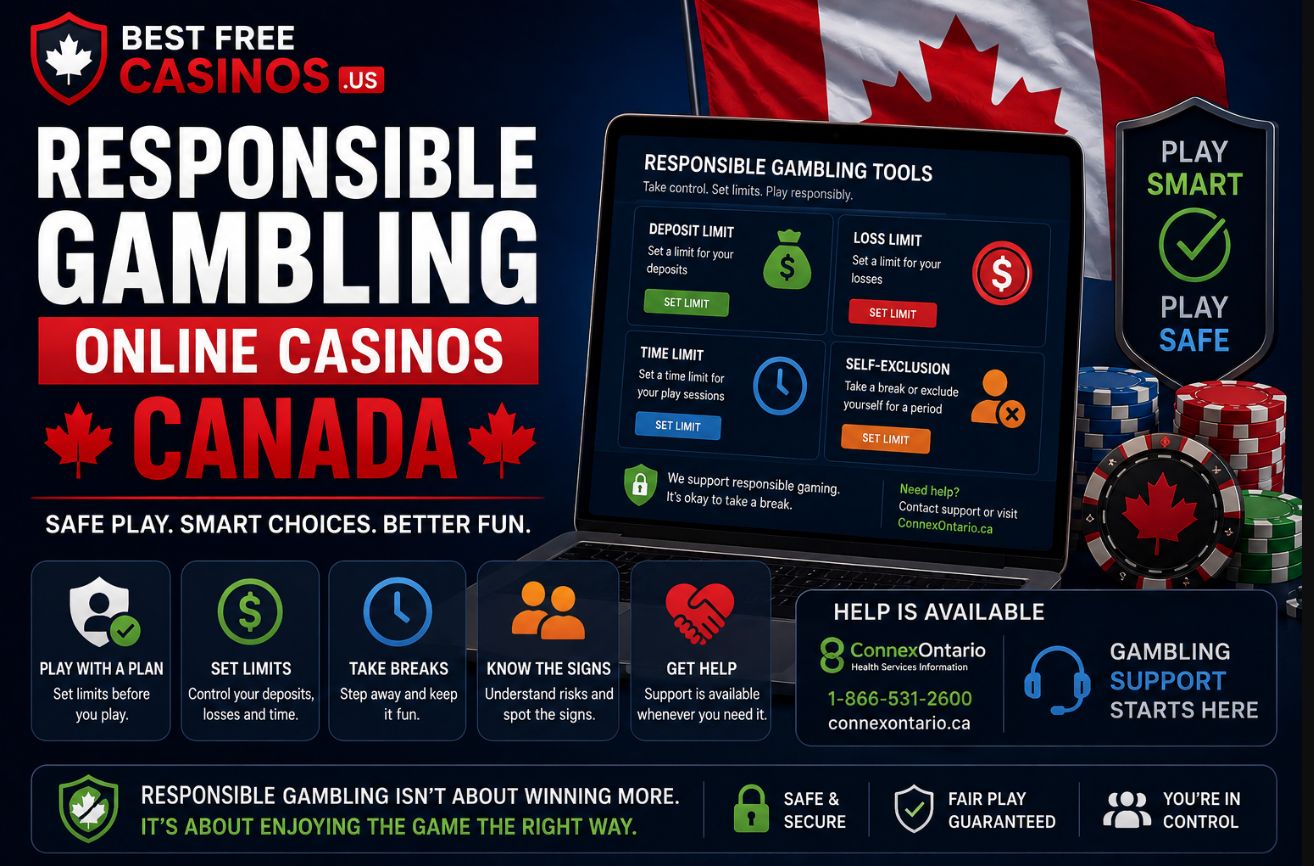
In a Nutshell
- Responsible gambling means treating online casino play as entertainment, not a way to make money or recover losses.
- Set a fixed budget before playing and never use money needed for bills, food, debt repayments, savings, or family expenses.
- Use casino tools such as deposit limits, loss limits, wagering limits, session timers, reality checks, time-outs, and self-exclusion.
- Do not chase losses, increase bets emotionally, or rely on betting systems to overcome the house edge.
- Read bonus terms carefully, as promotions can increase playtime and encourage spending beyond your original budget.
- Watch for warning signs such as hidden gambling, repeated deposits, borrowing money, stress, missed responsibilities, or failed attempts to stop.
- If gambling stops being enjoyable or affects your finances, mood, work, sleep, or relationships, take a break, self-exclude, and seek confidential support.
Responsible Gambling at Online Casinos in Canada
Responsible gambling means keeping casino play as paid entertainment rather than treating it as a way to earn money, solve financial problems, or recover losses. The best online casinos support this approach with deposit limits, loss limits, time reminders, time-outs, self-exclusion tools, and visible access to professional help.
For Canadian players, responsible gambling is especially important because online casinos are available around the clock, deposits can be instant, and games move quickly. A clear plan before you log in is more effective than relying on willpower after a losing session.
What Responsible Gambling Means
Responsible gambling is not about avoiding all gambling. It is about making informed decisions, setting limits, and stopping when play is no longer enjoyable or affordable.
A responsible player understands several basic facts:
- Casino games have a house edge.
- A win is never guaranteed.
- A previous loss does not make a win more likely.
- A long losing streak can happen in any game.
- A bonus does not remove the risk of losing money.
- Gambling should not be funded with money needed for rent, food, bills, debt payments, savings, or family expenses.
- Casino play should never be used as a financial plan.
Online casino games use different rules, payout structures, and volatility levels. A slot with a high advertised return to player percentage can still produce losing sessions. A table game with a low house edge can still result in short-term losses. Responsible gambling starts with accepting that outcomes are uncertain and that the casino has an advantage over time.
The healthiest mindset is simple: decide how much you are comfortable spending before you play, treat that amount as the price of entertainment, and stop when it is gone.
Why Online Casino Gambling Needs Limits
Online gambling can be more convenient than visiting a physical casino. You can play from a phone, tablet, or computer at any time. You can deposit within seconds, switch games immediately, and access promotions without leaving home.
That convenience can also make it easier to play longer or spend more than planned.
Several features can increase risk if they are not managed carefully:
- Fast game rounds.
- Autoplay settings.
- Instant deposits.
- Multiple payment methods.
- Push notifications and promotional emails.
- Welcome bonuses and reload offers.
- Live casino sessions that encourage extended play.
- Sports betting markets available throughout the day.
- Playing alone without natural breaks.
- Gambling late at night, when decision-making may be weaker.
A good responsible gambling plan creates friction before spending becomes impulsive. This might mean setting a strict deposit limit, removing saved card details, turning off promotional messages, or taking a scheduled break from gambling apps.
The goal is not to make gambling difficult for its own sake. The goal is to make sure your decisions remain deliberate.
Responsible Gambling Tools at Online Casinos
A reputable online casino should make player-protection tools easy to find in the account area. In Ontario’s regulated online gambling market, operators are expected to provide clear responsible gambling information and give players simple ways to set financial and time-based limits.
Tools differ between casinos, but the following are the most important.
Deposit Limits
A deposit limit controls how much money you can add to your casino account during a chosen period. Common options include daily, weekly, and monthly limits.
For many players, a deposit limit is the strongest first line of protection because it acts before money reaches the casino balance. Once the limit is reached, you cannot make further deposits until the period resets.
A useful approach is to set a monthly limit based on your entertainment budget. For example, if you can genuinely afford to spend CAD 80 per month on casino entertainment, set a monthly deposit limit of CAD 80 rather than relying on a daily decision.
Do not set a limit based on what you hope to win. Set it based on what you can lose without affecting your financial obligations.
Loss Limits
A loss limit tracks how much of your deposited money you lose over a selected period. It can be more useful than a deposit limit for players who frequently withdraw and redeposit or who gamble using a fluctuating account balance.
For example, a CAD 100 weekly loss limit means that once your net losses reach CAD 100, the casino should restrict further play for the rest of that period.
Loss limits are not always offered in the same way by every casino. If an operator only provides deposit limits, use them and maintain a separate personal record of your gambling spend.
Wagering Limits
A wagering limit restricts the total amount you can stake during a selected period. This tool is useful because frequent small bets can add up quickly, especially in slots, live casino games, or rapid sports betting markets.
A player may deposit only CAD 50 but wager CAD 500 or more through repeated spins, bets, or recycled winnings. A wagering limit controls betting volume rather than the cash deposited.
This is a valuable feature for players who find themselves chasing action even when their deposit budget has not been exceeded.
Session Time Limits
A session limit controls how long you can stay logged in or play without interruption. It can be set for a single session or over a longer period.
Time limits are important because fatigue can reduce judgement. After a long session, players may make larger bets, ignore their planned budget, or continue because they feel emotionally attached to a recent win or loss.
A practical session rule is to choose a fixed time before starting. For example, set a 45-minute casino session and stop when the reminder appears. Do not reset the timer simply because you are close to a bonus round, recovering losses, or waiting for one more result.
Reality Checks
Reality checks are on-screen reminders that show how long you have been playing and, in some cases, your net win or loss position.
They may feel disruptive, but that is their purpose. A reality check interrupts automatic play and gives you a chance to ask:
- How long have I been playing?
- How much have I deposited today?
- How much have I lost or won?
- Am I still having fun?
- Would I make the same decision if I stepped away for 10 minutes?
When a reality check appears, do not click through it automatically. Take a short break, stand up, get water, and reassess your plan.
Time-Outs and Cool-Off Periods
A time-out is a temporary restriction that prevents you from gambling for a selected period. Typical choices range from 24 hours to several weeks.
A time-out is useful when gambling has become stressful, when you are playing more frequently than intended, or when you want to stop but do not trust yourself to ignore casino promotions.
During a time-out, a responsible casino should block deposits, gameplay, and marketing messages. You should not be able to reverse the restriction immediately after setting it.
A cool-off period is not a failure. It is a proactive decision to protect your money and time.
Self-Exclusion
Self-exclusion is a stronger tool for players who need a longer break. It prevents access to an online casino for a defined period, often from six months to several years.
In Ontario, the province-wide BetGuard program allows eligible players to self-exclude from regulated digital gambling sites in one place for periods ranging from six months to five years. This is a more effective option than closing a single casino account when a player uses several regulated brands.
Self-exclusion should be considered when gambling is causing financial pressure, relationship conflict, emotional distress, secrecy, work problems, or repeated failed attempts to stop.
Do not view self-exclusion as punishment. It is a practical safety measure that creates distance between you and the activity causing harm.
Account Closure
Account closure is different from self-exclusion. A player may close an account for ordinary reasons, such as choosing another casino or taking a short break. Depending on the operator, a closed account may be reopened later.
If you are closing the account because gambling is harming you, use the self-exclusion option instead of a simple account closure. Ask customer support to confirm that the account is marked for responsible gambling exclusion and that promotional communications are stopped.
How to Set a Casino Budget
A responsible gambling budget should be separate from your regular finances. It should never include money needed for necessities or long-term financial goals.
Before gambling, calculate your available entertainment budget after covering:
- Rent or mortgage payments.
- Utilities.
- Food and household expenses.
- Transportation.
- Insurance.
- Debt repayments.
- Childcare or family commitments.
- Savings contributions.
- Emergency expenses.
Only after these costs are covered should you decide whether casino entertainment fits your budget.
A simple monthly plan can help. Suppose you have CAD 200 available for discretionary entertainment. You might decide that only CAD 40 belongs to online casino play, while the remaining CAD 160 is reserved for dining out, streaming, hobbies, travel, or other leisure activities.
Once you set the casino budget, treat it as a maximum, not a target. You do not need to spend it simply because it is available.
Avoid increasing your limit after a losing session. If you feel the urge to deposit more to win back money, stop playing. Chasing losses is one of the clearest signs that gambling is no longer following a safe plan.
Bankroll Management for Casino Players
Bankroll management is the practical side of responsible gambling. Your bankroll is the fixed amount you have chosen for casino entertainment.
Good bankroll management includes:
- Using a separate entertainment budget.
- Deciding your total loss limit before starting.
- Choosing a session limit.
- Keeping bets small relative to your total bankroll.
- Avoiding emotional increases in stake size.
- Taking regular breaks.
- Withdrawing winnings only after considering any bonus terms.
- Not redepositing withdrawn winnings immediately.
For example, a player with a CAD 50 session bankroll might decide to stop once the balance reaches CAD 0 or CAD 75. The CAD 75 point is not a guaranteed outcome; it is simply a pre-planned exit point if a win occurs.
The critical part is respecting the plan. A player who turns CAD 50 into CAD 75 and then loses everything because they continue chasing a larger win has not used the win as an opportunity to reduce risk.
There is no betting system that changes the house edge. Martingale, Fibonacci, doubling strategies, and similar systems can make losses grow faster. They do not create a reliable route to profit.
Casino Bonuses and Responsible Play
Bonuses can extend playtime, but they can also encourage deposits that a player would not otherwise make. A welcome bonus, free spins offer, cashback deal, or reload promotion should never be the reason you exceed your gambling budget.
Before accepting a bonus, check:
- Deposit amount required.
- Wagering requirement.
- Game contribution percentages.
- Maximum bet while wagering.
- Bonus expiry date.
- Restricted games.
- Maximum cashout limit.
- Whether the payment method qualifies.
- Whether you can cancel the bonus.
- Whether the offer encourages you to deposit more than planned.
A bonus with a high wagering requirement can turn a small deposit into a long session. If you are trying to control time or spending, a bonus may not be a good fit.
It is always acceptable to decline a promotion. Responsible gambling means choosing the offer only if it matches your budget and expectations.
Recognizing Warning Signs
Gambling problems do not always begin with a major financial crisis. They can start with smaller behaviour changes that become more frequent over time.
Possible warning signs include:
- Spending more than you planned.
- Increasing deposits after losses.
- Borrowing money to gamble.
- Using credit for gambling.
- Hiding gambling activity from family or friends.
- Feeling anxious, angry, or restless when unable to gamble.
- Gambling to escape stress, boredom, loneliness, or sadness.
- Missing work, sleep, studies, or responsibilities because of gambling.
- Trying to win money back immediately after losing.
- Making repeated promises to stop but continuing to gamble.
- Selling possessions or using savings to fund gambling.
- Thinking about gambling most of the day.
- Neglecting relationships because of casino play.
One sign does not automatically mean someone has a gambling disorder. However, several signs together are a strong reason to pause and seek support.
If gambling is no longer fun, it is time to act.
What to Do If Gambling Feels Out of Control
The first step is to make gambling less accessible immediately.
- Set a time-out or self-exclusion through each casino account.
- Use Ontario’s province-wide BetGuard program if you use regulated Ontario online gambling sites.
- Remove gambling apps from your phone and tablet.
- Delete saved payment cards from casino and e-wallet accounts.
- Unsubscribe from casino promotions, SMS alerts, and push notifications.
- Ask your bank about gambling transaction controls, where available.
- Tell a trusted friend, partner, or family member what is happening.
- Speak to a professional gambling support service.
You do not need to wait until you have lost a large amount of money. Early action is often easier and more effective.
For Ontario residents, ConnexOntario offers confidential information and support for gambling concerns. Canada also has provincial and community-based services, counsellors, and peer-support options for people affected by gambling.
Family members can seek help too. Problem gambling can affect household finances, trust, mental health, and relationships. Support is not only for the person placing bets.
Responsible Gambling for Friends and Family
If someone close to you may be struggling with online casino gambling, avoid shaming or arguing during a crisis. A calm, direct conversation is more likely to help.
You can say:
“I have noticed that gambling seems to be causing you stress. I am concerned about you, and I would like to help you find support.”
Practical ways to help include:
- Listening without judgement.
- Encouraging a time-out or self-exclusion.
- Helping them contact a support service.
- Discussing household financial safeguards.
- Suggesting a meeting with a financial counsellor.
- Avoiding loans that could fund further gambling.
- Keeping communication open.
Do not take control of someone’s finances without consent unless there is an urgent safety concern and you have legal authority. Focus on support, boundaries, and professional guidance.
Choosing a Responsible Online Casino
Not every casino approaches player protection with the same level of care. For Canadian players, responsible gambling tools should be part of the decision-making process, not an afterthought.
A responsible casino should provide:
- Clear age and location restrictions.
- A visible responsible gambling page.
- Easy-to-use deposit and time limits.
- Reality checks during play.
- Time-out and self-exclusion options.
- Clear customer support contact details.
- Links to gambling support services.
- Fair and transparent bonus terms.
- Secure payments and account verification.
- A process for handling player complaints.
- No marketing aimed at minors or self-excluded players.
Ontario-registered operators must meet standards that address responsible gambling, player account management, advertising, privacy, game integrity, and harm reduction. This offers a stronger baseline than an unregulated site that simply displays a generic “play responsibly” message.
Outside Ontario, players should check their provincial options and the casino’s licensing status. If a site does not clearly explain its licence, responsible gambling tools, or withdrawal policy, it is best to avoid it.
Myths That Can Lead to Harm
Several common beliefs can make casino gambling riskier.
“I Am Due for a Win”
You are not due for a win because of recent losses. Casino games do not owe you a result. Each spin, hand, or round follows its own rules and probabilities.
“I Can Win Back What I Lost”
Trying to recover losses by depositing more or increasing bets is chasing losses. It can turn a manageable loss into a serious financial problem.
“A Bigger Bet Will Solve It Faster”
Larger stakes increase the amount you can lose. They do not improve the mathematics of the game.
“A Bonus Gives Me Free Money”
A bonus usually comes with wagering requirements, restricted games, expiry dates, and other conditions. It can add entertainment value, but it is not risk-free money.
“I Can Stop After One More Spin”
This thought often appears when a player is tired, emotional, or chasing an outcome. Use a session limit or time-out instead of negotiating with yourself in the moment.
A Practical Responsible Gambling Checklist
Before you play, ask yourself:
-
Can I afford to lose this money without affecting my daily life?
-
Have I set a deposit limit?
-
Have I set a session time limit?
-
Am I gambling for entertainment rather than income?
-
Am I calm and sober?
-
Am I avoiding gambling to escape stress or sadness?
-
Do I understand the game and bonus terms?
-
Would I be comfortable telling someone close to me how much I plan to spend?
During play, ask:
-
Am I still within my planned budget?
-
Have I been playing longer than intended?
-
Am I increasing stakes because I am frustrated?
-
Am I trying to recover losses?
-
Is this still enjoyable?
After play, ask:
-
Did I follow my limits?
-
Do I feel comfortable with what I spent?
-
Should I take a break before my next session?
-
Do I need to tighten my limits or self-exclude?
Final Thoughts
Responsible gambling is not about predicting wins, finding a perfect betting system, or choosing a casino with the biggest bonus. It is about control.
Set a budget you can afford to lose, choose your limits before you play, take breaks, and stop when gambling becomes stressful or financially damaging. If casino play starts to affect your mood, finances, relationships, work, or sleep, use the available tools and reach out for support.
The right online casino experience should stay recreational. If it stops feeling like entertainment, the responsible choice is to pause.
Responsible Gambling FAQs
What is responsible gambling?
Responsible gambling means keeping casino play controlled, affordable, and recreational. You set limits before playing, understand that losses are possible, and never rely on gambling as a source of income.
What responsible gambling tools do online casinos offer?
Many online casinos offer deposit limits, loss limits, wagering limits, session limits, reality checks, time-outs, self-exclusion, account closure options, and marketing opt-outs. The exact tools depend on the casino and its licensing market.
What is a casino deposit limit?
A deposit limit restricts the amount of money you can add to your casino account over a chosen period, such as a day, week, or month. It helps prevent impulsive deposits and keeps spending within a pre-set budget.
What is the difference between a time-out and self-exclusion?
A time-out is a short-term gambling break that may last from 24 hours to several weeks. Self-exclusion is a longer restriction, often lasting months or years, and is intended for players who need stronger protection from gambling access.
Can I set gambling limits after I have already deposited?
Usually, yes. Most reputable casinos allow you to add or reduce limits through the responsible gambling section of your account. However, increases may take time to activate, while lower limits often apply immediately.
What are reality checks at online casinos?
Reality checks are on-screen reminders that show how long you have been playing and may display your deposits, wagers, wins, or losses. They are designed to interrupt automatic play and encourage you to review your limits.
How much money should I spend on online casino games?
Only spend money you can afford to lose after essential costs are covered, including housing, bills, food, transport, debt repayments, savings, and family expenses. Set a fixed entertainment budget and never increase it to recover losses.
Can I use a betting system to guarantee a casino win?
No. Betting systems, including Martingale and progressive staking methods, cannot remove the house edge or guarantee profit. Increasing stakes after losses can make financial harm happen faster.
What are signs that gambling may be becoming a problem?
Warning signs include chasing losses, gambling with borrowed money, hiding activity, missing work or responsibilities, feeling stressed when unable to gamble, repeated failed attempts to stop, and gambling to escape emotional problems.
How can I stop casino marketing emails and promotions?
Go to your casino account settings and opt out of email, SMS, push notifications, and promotional offers. If the option is unavailable, contact customer support and request that all gambling marketing communications be disabled.
What should I do if online gambling feels out of control?
Use a time-out or self-exclusion immediately, remove gambling apps, delete saved payment methods, unsubscribe from promotions, and speak with someone you trust. You can also contact a provincial gambling support service, counsellor, or responsible gambling organization for confidential help.
Can family members get support for problem gambling?
Yes. Gambling harm can affect partners, parents, children, and friends. Many gambling support organizations offer counselling, education, and practical guidance for family members as well as for the person who gambles.