In a Nutshell
- Casino KYC verification confirms your identity, age, address, payment ownership, and eligibility to gamble.
- You cannot reliably avoid KYC at a legitimate Canadian online casino if you want to deposit, claim bonuses, or withdraw winnings.
- Some casinos delay verification until your first withdrawal, a large transaction, or unusual account activity.
- Common KYC documents include a passport or driver’s licence, proof of address, payment-method evidence, and sometimes a selfie.
- Crypto and “no KYC casino” claims do not guarantee anonymous gambling or KYC-free withdrawals.
- Verify your account early, use accurate personal details, and deposit only with payment methods registered in your own name.
- Choose casinos with clear licensing, secure document uploads, transparent withdrawal rules, and responsible gambling tools.
Casino KYC Verification process
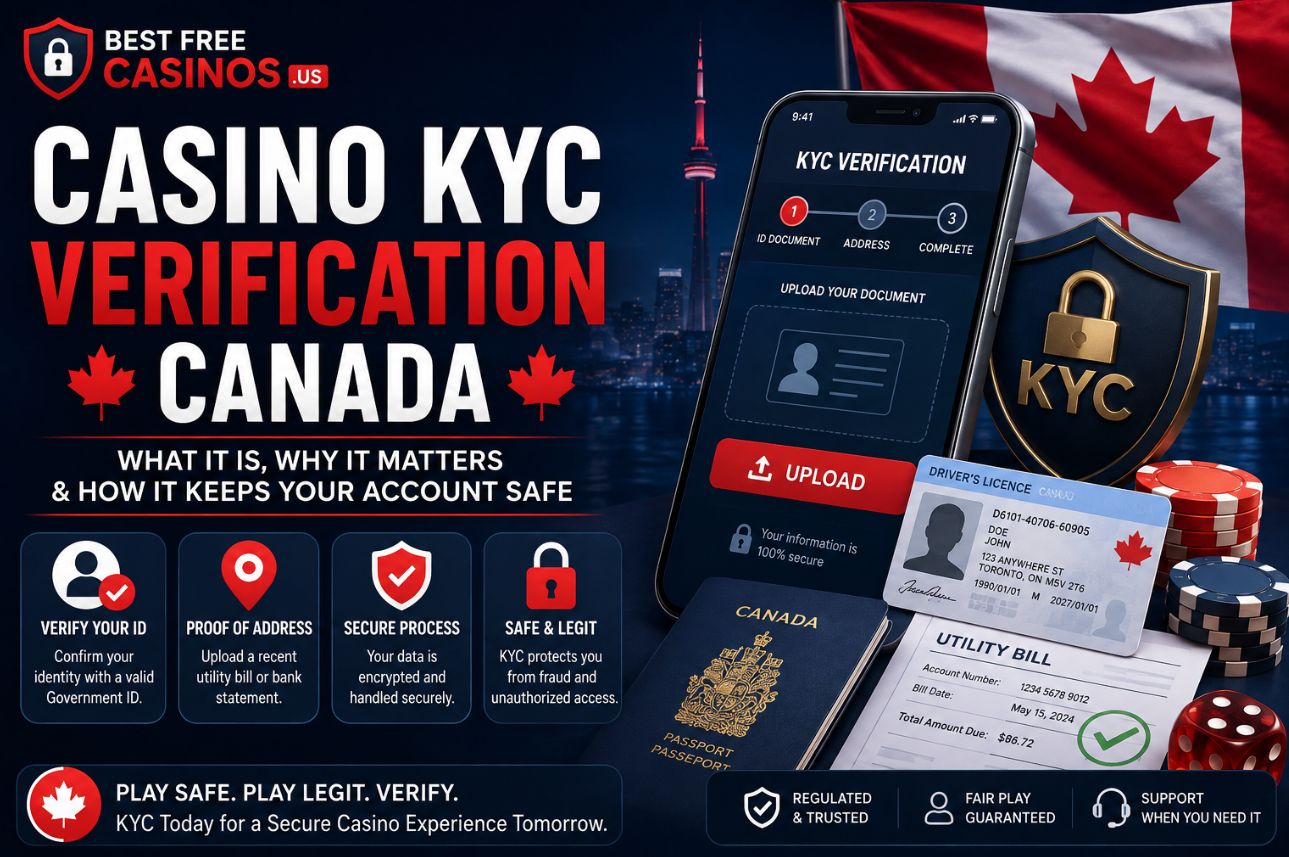
Casino KYC verification is a standard identity-check process used to confirm who a player is, where they live, and whether they are legally allowed to gamble. You may be able to browse some casino sites or play free demo games without it, but you generally cannot avoid KYC if you want to deposit, withdraw winnings, claim certain bonuses, or use a regulated online casino in Canada.
KYC can feel inconvenient, especially when a casino asks for documents immediately before a withdrawal. Still, a legitimate operator uses verification to prevent underage gambling, fraud, money laundering, duplicate accounts, payment abuse, and account takeovers.
What Does KYC Mean at Online Casinos?
KYC means “Know Your Customer.” It is a process used by casinos, banks, e-wallets, crypto exchanges, and other financial services to confirm that customers are genuine.
In an online casino setting, KYC normally checks:
- Your full legal name
- Your date of birth
- Your residential address
- Your location or provincial eligibility
- Your identity document
- Your payment-method ownership
- Whether you are connected to restricted or self-excluded accounts
- Whether your transactions trigger fraud or anti-money-laundering reviews
A casino may complete some checks automatically in seconds. For example, it may compare the name, address, and date of birth entered during registration against trusted data sources. If the result is clear, the account may be approved quickly.
Other situations require document verification. You may need to submit a photo of your driver’s licence, passport, provincial identity card, proof of address, or a selfie. The casino’s compliance team then reviews the information manually or through an identity-verification provider.
KYC is not designed to punish ordinary players. Its purpose is to make sure that the account holder is an adult, is using their own details, and is not abusing the platform.
Can You Avoid Casino KYC Verification?
The direct answer is no, not if you expect to use a reputable online casino normally and withdraw real-money winnings.
Some casinos may allow a player to register, deposit, or make small bets before asking for documents. That does not mean the casino has no KYC requirement. It usually means that verification has been delayed until a trigger occurs.
Common KYC triggers include:
- Your first withdrawal request
- A large deposit or withdrawal
- Multiple deposits from different payment methods
- A mismatch between your casino account and payment account
- A bonus claim
- A change to your personal details
- Unusual betting or transaction patterns
- A login from a new device or location
- A fraud or security alert
- A source-of-funds review
- A request from a regulator or payment provider
A player can sometimes avoid the inconvenience of a manual document upload by using accurate details that match reliable records. However, that is not the same as avoiding KYC. The verification may simply happen in the background.
Trying to bypass KYC by using false personal details, someone else’s payment card, a VPN, a fake document, or a different person’s identity is a serious mistake. The casino can freeze the account, void winnings, close the profile, report suspicious activity where required, and restrict future access.
The safest approach is to choose a transparent casino, verify early, and use payment methods registered in your own name.
Why Canadian Casinos Verify Players
Canada does not have one single national online casino regulator. Gambling regulation is largely provincial, while federal anti-money-laundering obligations apply to casinos through the Proceeds of Crime (Money Laundering) and Terrorist Financing Act.
For Canadian casino players, verification is especially important because operators must address several risks at once:
- Confirming the player is of legal gambling age
- Preventing minors from opening accounts
- Confirming the player is in an eligible province or territory
- Detecting self-excluded players
- Preventing identity fraud and payment fraud
- Monitoring money-laundering risks
- Complying with recordkeeping and reporting obligations
- Protecting the player from account theft
In Ontario’s regulated iGaming market, operators must collect and validate key player details before creating an account. This includes a player’s name, date of birth, address, contact details, login credentials, and information needed for anti-money-laundering compliance.
This means an Ontario-regulated online casino should not market itself as a truly “no verification” casino. It may use quick electronic checks instead of asking every player to upload documents, but it still has to validate account information.
Outside Ontario, the experience can vary more widely. Provincial gaming sites, international operators, and offshore casinos may use different onboarding systems. Even so, any casino that accepts real-money deposits and pays real-money withdrawals can ask for identity verification at any stage.
KYC Documents Canadian Players May Need
The exact document list depends on the casino, your payment method, transaction size, and the reason for the review. Most players only need to provide basic documents once.
Proof of Identity
A casino commonly accepts one valid government-issued photo ID, such as:
- Canadian passport
- Provincial driver’s licence
- Provincial or territorial photo ID card
- Permanent Resident Card
- Foreign passport, where accepted
- Other government-issued photo identification
The document must normally be current, readable, unaltered, and show your name, photo, date of birth, document number, and expiry date.
Do not crop important corners, edit the image, cover information unless specifically instructed, or submit a screenshot of a document. Casinos often reject poor-quality images because they cannot confirm that the document is valid.
Proof of Address
If your identity document does not show your current residential address, the casino may request a separate proof-of-address document. Common examples include:
- Bank statement
- Credit-card statement
- Utility bill
- Government letter
- Tax document
- Insurance statement
- Official tenancy or municipal document
Most casinos require a document issued within the last three months. It should show your full name, current address, issue date, and the issuer’s branding or official details.
A mobile phone bill is sometimes accepted, but not always. Screenshots, handwritten documents, and altered files are often rejected.
Payment Verification
A casino may ask you to prove that you own the deposit method. This is common when using debit cards, credit cards, e-wallets, or bank transfers.
For card verification, the casino may request an image of the card showing:
- Your name
- The first six and last four digits of the card number
- The expiry date, where required
You should always cover the middle card digits and the CVV security code. A legitimate casino should never ask you to reveal your full card number or CVV by email.
For e-wallets, the casino may request a screenshot showing your name, registered email address, account number, or recent transaction. For bank transfers, it may ask for a statement showing that the bank account is in your name.
Selfie or Liveness Check
Some casinos use a live selfie, short video, or facial-recognition check. This helps verify that the person submitting the ID is the same person opening the account.
A liveness check may ask you to move your head, blink, look into the camera, or hold your identification beside your face. It can feel intrusive, but it is increasingly common in regulated gambling and financial services.
No KYC Casinos: What the Term Really Means
The phrase “no KYC casino” is widely used online, but it is often misleading.
In most cases, a so-called no KYC casino means one of the following:
- It does not require documents when you register.
- It allows crypto deposits with limited initial checks.
- It delays verification until you request a withdrawal.
- It has a higher verification threshold for small transactions.
- It uses automated checks rather than manual document uploads.
- It promotes privacy but still reserves the right to request KYC.
The key phrase is usually hidden in the terms and conditions: the casino can request identity verification at any time.
A player may deposit and play without being asked for documents, then face a full KYC review after winning. This is why “no KYC” should never be treated as a guarantee that you can cash out anonymously.
The problem is not only the eventual document request. Casinos with weak identity controls may also offer weaker player protection. If the operator does not verify users properly, it may be harder to prevent minors, fraudsters, duplicate accounts, or self-excluded players from gambling.
For Canadians, the better question is not “Which casino has no KYC?” It is “Which casino has clear, fast, and fair KYC procedures?”
Is Crypto a Way to Avoid Casino Verification?
Crypto can provide more privacy than a bank card because blockchain transfers do not require you to type card or banking details into the casino cashier. However, crypto does not guarantee anonymous casino gambling.
A crypto casino can still ask for:
- Government-issued ID
- Proof of address
- A selfie or liveness check
- Wallet ownership evidence
- Source-of-funds documents
- Details about the origin of crypto deposits
- Enhanced checks for large withdrawals
Crypto transactions are also not automatically invisible. Public blockchain transactions can be traced, and regulated businesses may use blockchain-monitoring tools to assess risk.
A player who sends crypto from an exchange has often already completed verification with that exchange. The casino may still conduct its own checks.
Crypto is most useful when you understand wallet security, network fees, stablecoin risks, exchange-rate volatility, and address verification. It should not be chosen solely because you hope to avoid KYC.
Never send funds from a wallet or exchange account that belongs to someone else. Casino accounts and payment methods should always be in the same legal name.
When Casinos Ask for Source of Funds
Basic KYC proves identity. Source-of-funds checks go further. They are used when a casino needs to understand where the money in your account came from.
You may be asked for source-of-funds information after:
- A large deposit
- A large withdrawal
- A substantial increase in deposits
- High-value casino activity
- Frequent movement of money with little gameplay
- Multiple payment methods
- Large crypto transfers
- Activity that appears unusual for your account profile
Possible documents can include bank statements, payslips, tax returns, investment statements, business records, sale agreements, inheritance documents, or proof of a legitimate crypto transaction history.
This can be frustrating, especially if it happens after a big win. However, refusing to provide requested documents can prevent the casino from completing the withdrawal.
Players should never fabricate a source-of-funds explanation. If you do not want to share financial documents, choose a casino only after reading its enhanced due diligence policy and understanding that larger transactions can still trigger a review.
How Long Does Casino KYC Take?
KYC timeframes vary widely.
Automated checks can take seconds or minutes. A clear ID and address upload may be reviewed within a few hours. Manual reviews can take one to three business days, especially during weekends, holidays, or high-volume periods.
Complex cases may take longer. This can happen if:
- Your document is blurry or expired
- Your name differs across documents
- You recently moved
- Your account is registered with a nickname rather than your legal name
- The payment method belongs to another person
- Your documents are from another country
- You made a large withdrawal
- A source-of-funds review is required
- Your account has duplicate-account or bonus-abuse flags
The fastest method is to verify early. Do not wait until you have a large withdrawal pending. Complete KYC shortly after registration, before making a major deposit or claiming a bonus.
How to Pass KYC Quickly
A smooth verification process starts before you upload anything.
Use Accurate Registration Details
Enter your legal name exactly as it appears on your government-issued ID. Do not use a shortened name, middle-name variation, nickname, old address, or a family member’s contact details.
If your bank account says “Robert James Smith” and your casino account says “Bob Smith,” the mismatch can cause delays.
Use Your Own Payment Method
Deposit only with a card, e-wallet, bank account, or crypto wallet that you personally control. Third-party payments are one of the most common reasons for account restrictions.
Do not use a spouse’s card, a friend’s e-wallet, a shared bank account without clear ownership evidence, or a payment method linked to another casino profile.
Upload Clear Documents
Use natural light, place the document on a flat surface, and capture every edge. Ensure all text is readable. Avoid glare, shadows, flash reflection, filters, compression, and screenshots.
If the casino asks for both sides of an ID card, upload both sides. If it asks for a selfie with your document, follow the formatting instructions exactly.
Keep Your Address Current
If you moved recently, update the address with your bank, government records, and casino account before requesting a withdrawal. A current ID with an old address plus a new utility bill can be accepted, but it may require more review.
Read the Withdrawal Rules First
Check whether the casino requires withdrawals to be returned to the same method used for deposits. Some payment methods are deposit-only, which means the casino may need to pay your winnings through bank transfer, e-wallet, or another verified route.
This matters for Paysafecard, some mobile wallet deposits, and certain crypto or prepaid methods. A player who funds an account using a deposit-only method may still need to provide bank or e-wallet documents before receiving winnings.
KYC Red Flags to Watch For
KYC is normal. Poor KYC practices are not.
Be cautious if a casino:
- Does not explain its verification policy
- Hides KYC rules until after you deposit
- Requests full card numbers or CVV codes
- Asks you to email highly sensitive documents to an unverified address
- Does not use a secure upload portal
- Gives inconsistent answers about withdrawal verification
- Repeatedly asks for the same documents without explanation
- Rejects valid documents without stating why
- Promises anonymous withdrawals but later introduces unclear conditions
- Has no visible licence, ownership details, or customer support process
A trustworthy casino explains which documents may be needed, how it stores data, how long review usually takes, and what happens if documents are rejected.
Before submitting documents, check that you are on the casino’s official website. Use a secure connection, avoid public Wi-Fi, and never send ID images through social media or messaging apps.
KYC and Casino Bonuses
KYC is closely connected to bonus eligibility.
A casino may let you activate a welcome offer before verification, but it can require full identity and payment verification before paying any winnings. It may also reject a bonus-related withdrawal if it detects duplicate accounts, payment-method sharing, VPN use, or inaccurate registration details.
Read the bonus terms before accepting an offer. Pay attention to:
- Wagering requirements
- Maximum bet limits while wagering
- Restricted games
- Time limits
- Maximum cashout rules
- Payment-method exclusions
- Country and province restrictions
- One-account-per-household rules
- Identity-verification conditions
A large bonus is never worth losing access to a legitimate withdrawal because you ignored the terms.
Privacy and Data Protection
Providing identity documents to a casino involves a real privacy decision. You should only submit documents to established operators with clear privacy policies and secure account systems.
A casino may hold your information for legal, regulatory, fraud-prevention, and recordkeeping purposes. It may also use specialist identity-verification providers. Before uploading documents, look for clear explanations of:
- The information collected
- Why it is collected
- Who can access it
- Whether third-party KYC providers are used
- How long records are retained
- How to contact the privacy team
- How to request correction of inaccurate information
- How to make a complaint
Privacy is not the same as anonymity. A casino can protect your data properly while still requiring identity verification. The goal should be secure and proportionate verification, not a promise that identity checks will never happen.
The Best Alternative to Avoiding KYC
The best alternative is not trying to bypass KYC. It is choosing a casino with fast, transparent, and secure verification.
Look for an operator that:
- States its licence and ownership clearly
- Explains verification before you deposit
- Offers a secure document-upload system
- Uses established payment methods
- Provides responsive live chat or email support
- Lists withdrawal timeframes and limits clearly
- Supports responsible gambling controls
- Uses the same-name rule for accounts and payment methods
- Reviews documents quickly and gives clear rejection reasons
For most Canadian slots players, the ideal casino experience is one where KYC happens early, is completed once, and does not interrupt a legitimate withdrawal.
If a casino promises “no documents ever,” treat that claim carefully. Real-money gambling involves age restrictions, fraud controls, payment checks, and legal compliance. A platform that ignores all of those areas may create greater risks for the player.
Final Verdict
You cannot reliably avoid KYC verification at a legitimate online casino, especially if you want to deposit, claim bonuses, and withdraw winnings in Canada. Some sites delay the process or use automatic checks, but virtually every reputable operator retains the right to verify identity and payment ownership.
KYC is most manageable when you verify early, use your real details, choose payment methods in your own name, and keep clear copies of your ID and proof of address. It can protect both the casino and the player by reducing underage gambling, fraud, account theft, and payment disputes.
The best Canadian casino is not the one that advertises “no KYC.” It is the one that makes KYC clear, secure, reasonable, and fast.
Casino KYC Verification FAQs
What is KYC verification at an online casino?
KYC means “Know Your Customer.” It is the identity-check process casinos use to confirm your name, age, address, payment-method ownership, and eligibility to use the site.
Can I avoid KYC verification at a Canadian online casino?
Not reliably. Legitimate casinos can require identity verification before allowing deposits, bonuses, or withdrawals. Some may delay the request until you cash out, but they can still ask for documents at any time.
Why do online casinos ask for ID?
Casinos use ID checks to prevent underage gambling, fraud, money laundering, payment abuse, duplicate accounts, and account takeovers. Verification also helps operators meet licensing and compliance obligations.
What documents do casinos usually accept for KYC?
Most casinos request a government-issued photo ID, such as a passport, driver’s licence, or provincial photo card. They may also request proof of address, payment-method verification, and a selfie or live video check.
What can I use as proof of address?
A recent bank statement, utility bill, credit-card statement, government letter, tax document, insurance statement, or official tenancy document may be accepted. It should normally show your full name, current address, issue date, and the issuer’s details.
How long does casino KYC take?
Automatic verification may take minutes, while document reviews often take a few hours to several business days. Reviews can take longer if documents are unclear, personal details do not match, or a source-of-funds check is required.
Can a casino ask for KYC after I win?
Yes. Many casinos allow registration and deposits first, then require full verification before processing a withdrawal. This is why it is smart to complete KYC before making a large deposit or building up a sizeable balance.
Do crypto casinos require KYC?
They can. Crypto deposits may offer more payment privacy, but a crypto casino can still request ID, proof of address, a selfie, wallet ownership evidence, or source-of-funds information before approving a withdrawal.
Why is my casino KYC verification rejected?
Common reasons include blurry photos, expired documents, cropped images, mismatched names or addresses, proof-of-address documents that are too old, using another person’s payment method, or missing document pages.
Can I use someone else’s card or e-wallet for a casino deposit?
No. Casino accounts and payment methods should be in the same legal name. Using another person’s card, bank account, e-wallet, or crypto wallet can lead to account restrictions, rejected withdrawals, or account closure.
What is a source-of-funds check?
A source-of-funds check is an enhanced review that asks where your gambling money came from. Casinos may request bank statements, payslips, tax documents, investment records, or other evidence after high-value or unusual transactions.
Is it safe to send KYC documents to an online casino?
It can be safe when you use a licensed, reputable casino with a secure document-upload portal and clear privacy policy. Never send full card numbers, CVV codes, or ID photos through social media, public chat apps, or unverified email addresses.