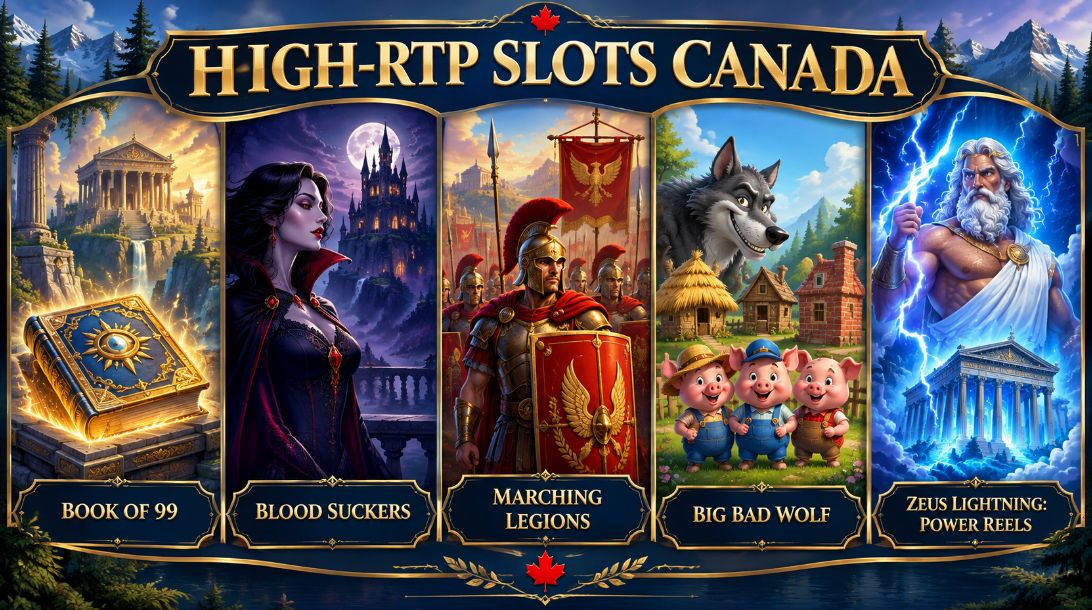
Key Points
- RTP: Return to Player describes a slot’s theoretical long-term return—not what you will receive during an individual session.
- House edge: A 98% RTP corresponds to a 2% theoretical house edge. Higher RTP reduces expected loss per dollar wagered but does not guarantee profit.
- Published figures: Book of 99 lists 99%, Marching Legions 98.12%, Blood Suckers 98% and Zeus Lightning Power Reels 97.73%. Confirm the actual casino configuration before playing.
- Big Bad Wolf correction: Quickspin currently documents 90% and 97% models. Do not assume the frequently quoted 97.34% applies to your version.
- Local availability: All five titles were not independently verified across both provincial markets. Check the exact game in an authorized Ontario or Alberta casino.
- Volatility: High-RTP games can still produce long losing stretches. Compare volatility and stake size alongside the payout percentage.
- Regulation: Ontario players must be 19+ and use provincially authorized platforms. Alberta’s minimum age is 18, with authorization involving AGLC and AiGC.
- Certification: Testing supports compliance with game standards; it does not mean a session’s results will match the theoretical RTP.
- Spending controls: Set deposit, loss and time limits before playing. More wagering can outweigh the mathematical advantage of choosing a higher-RTP game.
- Bottom line: Verify the operator, game version and displayed RTP. Treat slots as paid entertainment, not an income strategy.
High-RTP Slots Canada: Payout Percentages and Game Checks for Ontario and Alberta
A slot’s animation tells you how it looks. Its Return to Player tells you something more useful: the proportion of total stakes the game is mathematically designed to return over extensive play.
For value-conscious Canadian players, RTP deserves attention before the first wager. However, it is not the only important measure. Volatility, stake size, game configuration and total wagering can matter just as much to a short session.
A 99% RTP slot still has a theoretical house advantage. It can also deliver a substantial loss before a player experiences anything resembling its long-run average.
Ontario and Alberta provide provincial frameworks for regulated online gambling. Ontario players must be aged 19 or over. Alberta’s minimum gambling age is 18. Both markets require eligible operators and relevant gaming systems to satisfy applicable standards, but their regulatory organizations differ.
This guide examines five requested high-RTP titles using developer information where available. It also identifies an important correction: Big Bad Wolf should not automatically be assigned 97.34% at every casino. Quickspin’s current product page describes 90% and 97% models.
There is another limitation. No complete, current catalogue check established that all five games are available at licensed platforms in both provinces. These are titles to investigate—not a verified list of the five highest-paying slots legally accessible everywhere in Ontario and Alberta.
Nor do we claim independent game simulations or measured session results. A credible review distinguishes published mathematical information from the configuration actually deployed by an operator.
The practical objective is to compare theoretical value while controlling expenditure. Higher RTP can reduce expected loss for equivalent wagering. It cannot guarantee bankroll preservation, extend every session or turn pokies-style casino entertainment into income.
For eligible adults only: 19+ in Ontario and 18+ in Alberta. Gambling involves financial risk.
Understanding RTP, House Edge and Volatility
RTP measures turnover, not deposits
Return to Player is a theoretical percentage of total stakes returned through prizes across sufficiently extensive play.
A 98% RTP corresponds to a 2% theoretical house edge. Across a very large volume of wagering, the mathematical model allocates an average of 98 cents in prizes for each dollar staked.
That does not promise $98 back during a session starting with $100.
The distinction is turnover. Players can wager the same money repeatedly. A $50 deposit might support $200 in total stakes before the account reaches its stopping point.
For a game with a fixed theoretical return, expected loss can be expressed as:
At $200 in turnover, a hypothetical 98% RTP implies a $4 mathematical expected loss. At 96%, the corresponding figure is $8.
These are expectations, not predictions.
Higher RTP reduces an edge
Moving from 96% to 98% halves the theoretical house edge from 4% to 2%.
That is a meaningful mathematical difference when wagering conditions are otherwise comparable. It does not mean the chance of winning a session doubles.
Game outcomes can distribute return very differently. One game may deliver frequent modest prizes; another may concentrate more of its return in uncommon larger outcomes.
A higher-RTP game also loses its comparative advantage if the player compensates by wagering substantially more. Lower expected loss per dollar is not protection against increasing turnover.
Volatility describes uneven returns
Volatility refers to the variability of results around the game’s expected return.
Low, medium and high are broad categories rather than a universal scale shared identically by every provider. Where possible, check the developer’s description and the deployed rules.
Hit frequency is different again. It counts qualifying winning outcomes, which can include prizes smaller than the stake. Frequent wins do not necessarily mean frequent profits.
Neither format creates a winning strategy. The comparison helps match expectations to risk.
Why Provincial Regulation Matters
Ontario uses AGCO and iGO
The Alcohol and Gaming Commission of Ontario (AGCO) regulates participating operators and suppliers. iGaming Ontario (iGO) conducts and manages the regulated gambling offered through contracted private operators.
Check the exact website in iGO’s directory. A recognizable brand or an international licence does not establish Ontario authorization.
The minimum gambling age is 19, and applicable provincial location requirements must be satisfied when wagering.
Alberta uses AGLC and AiGC
Alberta Gaming, Liquor and Cannabis (AGLC) regulates Alberta’s commercial market. The Alberta iGaming Corporation (AiGC) manages participation through agreements with eligible operators.
An AGLC registration and completed commercial-market authorization should not be treated as interchangeable claims.
Alberta players must be at least 18. Verify the current player-facing website through official information before opening or funding an account.
A game’s appearance on an international casino page does not prove availability through either provincial product.
Testing is more than an RNG badge
Relevant games, random number generators and critical gaming components must satisfy the applicable testing and certification requirements.
An RNG produces outcomes according to the approved game design. Testing also considers relevant game behaviour, mathematical information and system requirements.
Ontario’s published laboratory list includes eCOGRA and other registered organizations. eCOGRA also describes services aligned with Alberta’s framework.
Do not assume a laboratory is currently authorized in a province merely because its name is internationally familiar. Check the regulator’s requirements and the relevant laboratory status.
Certification is not session verification
It would be misleading to say licensing guarantees that each session’s observed return matches the displayed RTP.
A certified 98% game can produce a losing session. It can also produce a session returning much more than the amount wagered.
The mathematical percentage describes the model across extensive play, not a repayment schedule.
Likewise, certification is not a promise that every available configuration has the developer’s highest published RTP. The actual deployed version remains the important check.
Regulated does not mean identical
Locally regulated operators provide a clearer framework for standards, oversight and complaints than websites operating outside the provincial system.
However, regulation does not make all catalogues, stake ranges or payment conditions equal.
An offshore game may come from a genuine supplier, but that does not substitute for provincial authorization or establish equivalent local protections.
Compare the game and the operator separately: one concerns mathematics and product design; the other concerns eligibility, account administration, payments and safeguards.
Five High-RTP Slots to Investigate
The following figures are developer-published reference values or clearly identified reported figures. They are not independently verified Ontario or Alberta configurations.
No claim is made that these are the absolute five highest-RTP games in either province.
1. Book of 99 — Relax Gaming
Relax Gaming launched Book of 99 with a published 99% RTP. It is the highest developer-published percentage among the five titles examined here.
-
Theme: Mythological exploration within a “Book of” slot format.
-
Published RTP: 99%.
-
Theoretical house edge: 1%, if that configuration applies.
-
Volatility: Commonly classified as high; classifications vary between secondary sources.
-
Main mechanic: A selected symbol gains expanding behaviour during the triggered feature.
Relax describes two routes to its feature: the conventional three-symbol trigger and collecting 99 books in the base game.
Read the deployed rules carefully. Determine how collection progress is recorded and which conditions apply to the mathematical model.
A counter approaching its target can encourage longer play. Do not extend a session simply to finish it.
Book of 99 demonstrates that high theoretical return and substantial volatility can coexist. The 1% edge is not a 99% chance of winning.
Canadian editorial coverage associates the game with BetMGM, but that does not establish availability in both provincial catalogues. Confirm the title and percentage inside the applicable platform.
2. Blood Suckers — NetEnt
NetEnt’s current product page publishes a 98.00% RTP for the original Blood Suckers.
-
Theme: Gothic vampires and horror imagery.
-
Published RTP: 98.00%.
-
Theoretical house edge: 2%.
-
Volatility: Widely described as low in secondary coverage.
-
Structure: Five reels, three rows and 25 paylines.
NetEnt also publishes a 45% hit frequency. That figure must not be read as a 45% chance of making a profit: qualifying prizes can be smaller than the stake.
The original includes wild substitutions, a scatter-triggered feature and a coffin-selection game.
Its appeal is mathematical return combined with a comparatively less variable reputation. Nevertheless, neither characteristic guarantees a gentle session.
Confirm that the lobby contains the original. Blood Suckers 2 is a separate product with a developer-published 96.94% RTP.
A sequel can share branding while carrying different mathematics. Exact naming prevents an apparently small catalogue mistake from becoming a misleading comparison.
3. Marching Legions — Relax Gaming
Relax Gaming’s launch announcement publishes a 98.12% RTP and explicitly describes Marching Legions as high volatility.
-
Theme: Stylized Roman military imagery.
-
Published RTP: 98.12%.
-
Theoretical house edge: 1.88%.
-
Volatility: High.
-
Main mechanics: Marching stacks, nudges, respins and collection meters.
The developer describes full stacks moving across the reels and triggering respins. Recorded stacks contribute to a meter, with further collection mechanics operating during the triggered feature.
This structure deserves attention beyond the headline percentage.
Read whether progress persists and how the feature’s contribution is reflected in the displayed return. Do not assume a short session experiences every component of the theoretical model.
Secondary player commentary raises questions about session length and collection-related return, but that is not sufficient evidence to rewrite the developer’s mathematics.
The practical response is to inspect the rules, not to chase a meter. Stop at the planned time and financial boundary even when progress appears close.
4. Big Bad Wolf — Quickspin
Big Bad Wolf requires the clearest correction in this shortlist.
Although 97.34% is widely quoted in older and secondary listings, Quickspin’s current product page states that the game comes in 90% and 97% models.
-
Theme: The Three Little Pigs.
-
Current developer reference: 90% and 97% RTP models.
-
Frequently reported figure: 97.34%, which requires deployment-specific confirmation.
-
Volatility: Quickspin describes the game as high volatility.
-
Main mechanic: Swooping Reels combined with pig symbols becoming wild.
Winning symbols are replaced during swoops. After successive qualifying swoops, pig symbols can become wilds.
The triggered feature includes house-blowing mechanics and additional modifiers.
The difference between a 90% and approximately 97% model is material. A player cannot infer the better percentage from the title alone.
Do not rank this game above another using 97.34% unless the actual game displays that configuration. If the information is unavailable, ask support or choose a product with clearer disclosure.
This is precisely why developer branding and local regulation do not remove the need to inspect the deployed version.
5. Zeus Lightning: Power Reels — Red Tiger
Red Tiger’s official page publishes a 97.73% RTP for Zeus Lightning Power Reels.
-
Theme: Zeus and Greek mythology.
-
Published RTP: 97.73%.
-
Theoretical house edge: 2.27%.
-
Volatility: Secondary descriptions classify it as high or very high.
-
Main mechanic: Zeus lightning expands selected symbols across the reels.
The developer explains that the Zeus symbol sends lightning across the layout, expanding symbols, including in non-adjacent positions.
That presentation can create conspicuous feature outcomes. It does not establish a favourable next spin.
Check the full title. Zeus Lightning Megaways is a different product, and Red Tiger publishes a different RTP for it.
Mobile scaling also deserves a practical check. Make sure rules, total stake and account controls remain readable on your device. This review does not claim independently tested app performance.
As with the other titles, current Ontario and Alberta availability remains a local catalogue question.
Finding the Actual Highest-RTP Version
A useful selection process is more reliable than a static “best-paying” list.
-
Verify the casino’s provincial authorization.
-
Search the exact game title.
-
Open its information or rules panel.
-
Find the displayed theoretical return.
-
Check the applicable mode and configuration.
-
Review volatility, stake range and feature rules.
-
Record the operator and date of the check.
Do not substitute a developer’s euro-denominated stake range for the Canadian deployment’s limits.
If a game has several modes, purchased features or enhanced stakes, inspect whether separate mathematical information applies. Availability of those mechanics also depends on the provincial product.
A screenshot of a rules panel can support a dated review. It should identify the platform and version rather than floating without context.
A genuine “highest RTP available” ranking requires a sufficiently complete current catalogue comparison. This guide does not have that evidence, so it provides a documented shortlist instead.
Bankroll Management Without Winning Claims
Set the budget before selecting the game
Start with a maximum entertainment spend that excludes rent, bills, savings and essential commitments.
Then choose a stake compatible with that boundary. The smallest available stake may be the most practical option, particularly for a volatile game.
There is no universally safe percentage of bankroll to wager. A stake that seems modest can still exhaust a budget through repeated play.
Do not deposit more because the chosen game has a high RTP.
Control turnover and pace
High RTP reduces theoretical loss per dollar under comparable conditions. It does not cap the number of dollars wagered.
Track total stakes where the account provides that information. Also record net deposits, withdrawals, session duration and ending balance.
Faster play increases the rate at which turnover can accumulate. Manual pacing and planned breaks can help keep the session within its intended boundaries.
Do not attempt to recover losses through larger stakes.
Use different limits for different risks
Deposit limits restrict incoming money. Loss limits address net financial loss according to the platform’s calculation. Time controls address session exposure.
Ontario and Alberta require financial and time-based safeguards within their respective frameworks.
Both frameworks include cooling-off requirements before established limits can be relaxed. However, interface names and presentation can differ.
Do not assume every platform provides the same countdown timer or reality-check popup. Inspect the actual controls.
Set the limits before play, not after a difficult session.
Stop independently of the reels
A stopping decision should not depend on a nearly full meter, a recent large prize or several losing spins.
Random outcomes do not owe compensation. Previous losses do not establish better odds on the next attempt.
If limits are repeatedly overridden or gambling starts affecting essential spending, a short break may be insufficient.
Review site-level and centralized self-exclusion. Ontario’s BetGuard and Alberta’s AGLC program have different scopes and terms.
Support is available through ConnexOntario in Ontario and Alberta’s GameSense resources and service-referral channels. Seeking assistance is a protective decision, not a failure.
Conclusion: Better Information, Not Better Promises
High-RTP comparisons can improve understanding of theoretical value. They cannot guarantee a winning session or neutralize gambling risk.
Among the requested titles, Book of 99 has the highest developer-published reference percentage at 99%. Blood Suckers, Marching Legions and Zeus Lightning Power Reels also have strong published figures. Big Bad Wolf requires particular caution because the developer documents materially different models.
The larger limitation is availability. These five games were not independently verified across both Ontario and Alberta catalogues, and they should not be advertised as universally accessible at Betway, JackpotCity or another named operator.
If you decide to play, begin with the official provincial operator directory. Inspect the actual game’s rules and RTP before funding the account.
Compare volatility and stake size alongside the headline percentage. Establish deposit, loss and time limits, and keep total wagering within the planned budget.
A higher return is useful only as part of an informed comparison. It is not a reason to increase spending or continue until a feature arrives.
The strongest player-first approach is transparent: verify authorization, verify the configuration, acknowledge uncertainty and stop when the preset boundary is reached. Not gambling remains a valid choice.
High-RTP Slots Canada FAQs
What does RTP mean in online slots?
Return to Player (RTP) describes the theoretical percentage of total stakes a slot returns through prizes over extensive play. A 98% RTP does not promise that a player will receive $98 back during a $100 session. Individual results can differ substantially from the long-run average.
Which slot has the highest RTP in this guide?
Book of 99 has the highest developer-published reference figure among the five reviewed titles, at 99%. That does not establish it as the highest-RTP slot available across every Ontario or Alberta casino. Confirm its local availability and the percentage displayed inside the deployed game.
What RTP figures do the five featured slots have?
The guide identifies these published reference figures:
- Book of 99: 99%.
- Marching Legions: 98.12%.
- Blood Suckers: 98%.
- Zeus Lightning Power Reels: 97.73%.
- Big Bad Wolf: Quickspin currently documents 90% and 97% models.
These figures should not automatically be assigned to every casino deployment.
Are all five high-RTP slots available in Ontario and Alberta?
Their availability across both provincial markets was not independently verified in this guide. Search the exact title in an authorized casino’s current lobby and inspect its rules. International availability or a provider partnership does not prove that a particular game is offered locally.
How can I check a slot’s actual RTP?
Open the game’s information, help or rules panel and look for its theoretical return. Confirm the complete title, version and applicable mode. If the percentage is missing or conflicts with a review, ask the operator for clarification rather than assuming the highest published configuration applies.
Does higher RTP mean I am more likely to win a session?
Not necessarily. Higher RTP means a lower theoretical house edge under comparable wagering conditions, but session results also depend on the game’s prize distribution and volatility. A high-RTP slot can still produce a substantial loss.
What is the difference between RTP and volatility?
RTP describes theoretical long-term return. Volatility describes how unevenly outcomes are distributed. Two slots with similar RTP can offer very different experiences: one may distribute more return through frequent smaller prizes, while another concentrates it in uncommon larger outcomes.
Do regulated casinos guarantee that I will receive the stated RTP?
No. Testing and certification support compliance with applicable game and system standards; they do not guarantee that your session will match the mathematical average. You must also check the deployed configuration, because a title can have more than one RTP model.
What age must I be to play regulated online slots?
Ontario players must be at least 19, while Alberta’s minimum gambling age is 18. Provincial eligibility and location requirements also apply. Verify the exact casino website through official provincial information before registering or depositing.
How should I manage spending when playing high-RTP slots?
Set deposit, loss and time limits before playing, use modest stakes and track total wagering rather than deposits alone. Do not increase spending because a game has a higher RTP or a feature appears close. Higher theoretical return is a comparison tool—not protection against excessive play.
Sources
- Relax Gaming: Book of 99 mechanics.
- Relax Gaming: Published 99% RTP.
- NetEnt: Blood Suckers specifications and 98% RTP.
- NetEnt: Blood Suckers 2 comparison.
- Relax Gaming: Marching Legions RTP and volatility.
- Relax Gaming: Marching Legions collection mechanics.
- Quickspin: Big Bad Wolf’s 90% and 97% models.
- Red Tiger: Zeus Lightning Power Reels and 97.73% RTP.
- iGaming Ontario: Official operator directory.
- AGCO: Registered testing laboratories.
- AGCO: Internet gaming standards and safeguards.
- AGLC: Alberta internet gaming standards.
- AiGC: Registered Alberta gaming websites.
- eCOGRA: Alberta testing services.